Published February 4, 2026
AI vs Human Support: Why Hybrid Customer Service Models Win

Customer support is rapidly shifting toward automation. More companies now rely on AI customer support to handle high volumes of requests, provide instant responses, and stay available 24/7. Customer service automation has become a core part of modern business operations.
This shift has intensified the AI vs human debate in customer service. AI delivers clear advantages in scalability and efficiency, especially for repetitive tasks such as order tracking, FAQs, and basic troubleshooting. At the same time, human customer service remains essential for complex situations that require context, trust, and judgment.
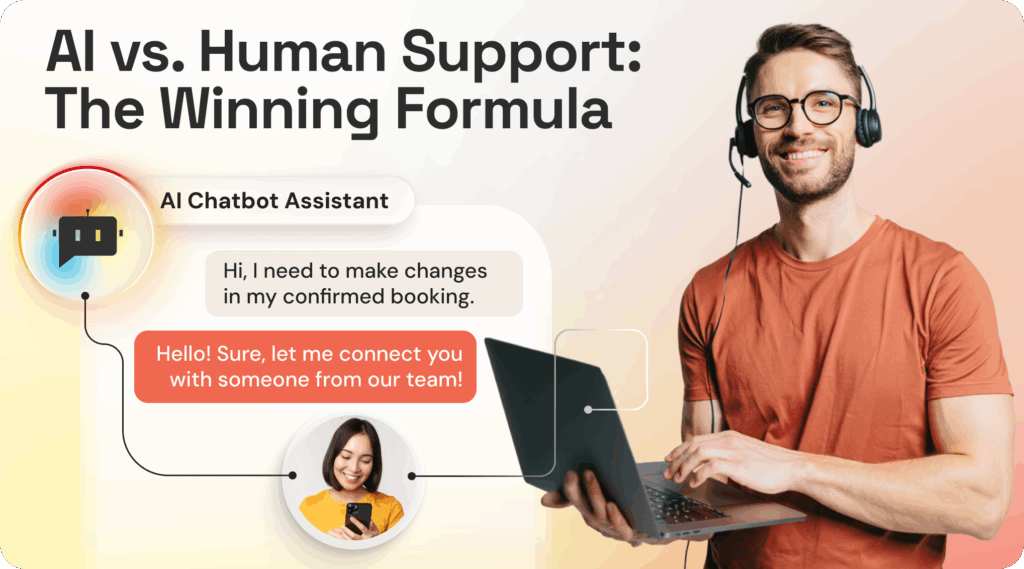
Relying fully on one approach creates limitations. AI-only support struggles with unusual cases, while human-only teams are expensive and difficult to scale. As a result, many businesses are adopting hybrid customer service models that combine automation with structured human handover.
This is where solutions like Triviat fit naturally. Triviat provides fully configured and trained AI customer support systems integrated into existing workflows. Routine requests are resolved automatically, while seamless handover ensures human teams step in only when needed.
In this article, we’ll compare AI and human support and explain why hybrid customer service powered by trained AI is becoming the most effective approach for growing businesses.
AI vs Human in Customer Service: The Core Difference
When discussing AI vs human support in customer service, the main difference lies in how tasks are processed and resolved.
AI customer support is built for speed and scale. It handles large volumes of requests simultaneously and provides instant responses around the clock. Automated support works best for predictable workflows such as order tracking, password resets, subscription changes, and basic product questions.
Human customer service focuses on context and decision-making. Human agents understand emotions, interpret complex situations, and adapt their responses when issues do not follow standard patterns. This makes people more effective in cases involving technical problems, disputes, or sensitive requests.
AI improves efficiency and reduces workload. Humans ensure accuracy, trust, and proper resolution. Each approach addresses different parts of the customer journey.
Strengths of AI Customer Support
AI customer support plays a key role in modern customer service automation by handling high-volume and repetitive workflows with speed and consistency.
One of the biggest advantages is instant availability. AI systems respond within seconds and operate 24/7, which is especially valuable for global businesses and online services. For example, in retail, businesses use AI customer support for eCommerce to handle order tracking, shipping updates, and return policies outside business hours, reducing wait times and support backlogs.
SaaS companies use automated support to guide users through onboarding and basic setup in real time, improving early product adoption.
AI customer support also improves cost control. Instead of expanding support teams as ticket volumes grow, businesses automate predictable requests at scale. This keeps operational costs stable even during rapid growth or seasonal spikes. In fintech, for example, balance inquiries, transaction status checks, and account recovery flows are commonly automated, allowing human teams to focus on fraud cases and disputes.
Another major strength is consistency. Automated support delivers the same accurate responses across thousands of conversations, reducing human error in routine tasks. This is especially important in regulated industries and high-volume environments where incorrect information can create additional workload.
Finally, AI scales instantly during traffic spikes. Promotions, product launches, and service disruptions often cause sudden increases in support demand. AI customer support absorbs these surges without delays, maintaining service levels when human teams would struggle to keep up.
Where Human Customer Service Still Wins
AI customer support is highly effective for routine workflows, but human customer service remains essential in situations that require context, judgment, and trust.
Human agents perform best when issues are complex or involve multiple systems and policies. In industries such as telecom, SaaS, and eCommerce, problems often include billing conflicts, service interruptions, technical bugs, or delivery complications. These cases rarely follow standard flows and require flexible problem-solving that automated support struggles to provide.
Emotional situations also benefit from human interaction. Customers dealing with failed payments, service outages, or urgent delivery issues expect clear explanations and reassurance. Human customer service can adapt communication in real time, acknowledge concerns, and prevent frustration from escalating.
Another area where people add value is in sensitive decisions. Refund approvals, fraud investigations, chargebacks, and escalations related to compliance or high-value accounts require accountability and contextual understanding. These actions are typically beyond the scope of automated systems.
These scenarios explain why the AI vs human discussion is not about replacement. AI customer support improves efficiency at scale, while human customer service protects service quality and customer trust.
Turnkey AI solutions like Triviat are built with this balance in mind. Triviat’s trained AI resolves routine interactions independently, while seamless human handover ensures complex or sensitive cases are handled by support teams when needed — without disrupting the customer experience.
The Problem with “AI-Only” Support
Many businesses adopt AI customer support to improve speed and reduce workload. However, relying entirely on automation often creates new challenges that affect customer experience.
One common issue is limited understanding of context. AI systems follow predefined workflows and patterns. When customer requests fall outside expected scenarios, responses can become inaccurate or incomplete. For example, in eCommerce, customers often combine multiple issues into a single message, such as a delayed shipment and a wrong product. AI chatbots may address only one part of the problem or provide generic replies.
Another risk is incorrect or misleading information. AI customer support can sometimes generate confident responses that are not fully accurate. In SaaS environments, this may result in wrong setup instructions or feature explanations. In fintech, it can involve incorrect transaction details or policy information. These errors quickly damage trust.
AI-only support also struggles with emotional situations. Automated systems rarely adjust tone or acknowledge frustration in a meaningful way. Common scenarios include:
- service outages
- failed payments
- urgent delivery problems
In these moments, customers often request a human agent or abandon the interaction altogether.
Over time, these issues can increase churn. Instead of reducing workload, AI-only support may lead to repeated contacts, escalations, and lower satisfaction.
This is why the AI vs human debate is shifting away from full automation. While AI customer support improves speed and scale, businesses increasingly combine it with controlled human handover to maintain service quality.
Turnkey AI platforms like Triviat reduce these risks by deploying trained AI systems from day one and setting up clear escalation paths. Routine requests are handled automatically, while complex or sensitive cases are seamlessly transferred to human teams.
What Is Hybrid Customer Service?
Hybrid customer service combines AI customer support with human customer service within a single support workflow.
Instead of relying solely on automation or human teams, businesses use AI to handle high-volume, routine requests and involve people when a deeper understanding or decision-making is required.
In most support operations, a large share of incoming requests follows predictable patterns. These commonly include:
- order and delivery updates
- account changes and password resets
- subscription management
- basic product questions
AI customer support automates these workflows and provides instant responses.
More complex requests are escalated to human agents through human handover. These often involve unusual scenarios, emotional situations, or cases that impact revenue and customer trust.
This model allows businesses to scale support operations efficiently while maintaining high service quality.
Solutions like Triviat make hybrid customer service easier to adopt by providing fully configured and pre-trained AI systems. Triviat takes care of setup, integrations, and workflow design based on real business needs, minimizing implementation time and reducing operational risk.
With Triviat in place, routine customer interactions are resolved automatically, while seamless handover ensures human teams step in only when necessary.
Hybrid customer service bridges the gap in the AI vs human discussion. AI customer support delivers speed and scalability, while human customer service protects quality and trust.
Together, they form a practical approach to modern customer service automation.
Human Handover: Why This Approach Delivers Better Results
Human handover is not just a technical feature of hybrid customer service. It is the mechanism that protects service quality while allowing AI customer support to scale.
The main goal of human handover is to prevent automation from handling situations where mistakes can impact customer trust or revenue. Instead of forcing every interaction through automated flows, AI escalates specific cases to human customer service teams based on predefined conditions.
This approach significantly reduces common risks of customer service automation, including:
- incorrect responses in complex scenarios
- repeated automated loops that frustrate customers
- poor handling of emotional situations
By transferring these cases early, businesses avoid negative experiences before they escalate.
Human handover also improves overall efficiency. AI customer support resolves the majority of routine requests in seconds, while human agents spend their time on high-impact interactions such as technical issues, disputes, refunds, and escalations. This leads to faster resolution times across the entire support operation.
Solutions like Triviat are designed to make human handover reliable from day one. Triviat deploys trained AI systems with built-in escalation logic based on real business workflows. During implementation, handover rules are configured to match customer behavior, risk levels, and service priorities.
Because the AI is pre-trained and integrated into existing tools, most interactions are resolved accurately without human involvement. When escalation happens, human teams receive full context, reducing back-and-forth and resolution delays.
Human handover allows businesses to scale AI customer support confidently while maintaining control over customer experience and service quality.
Real Use Cases of Hybrid Customer Support
Hybrid customer service delivers measurable business impact when AI customer support is combined with structured human handover. Below are condensed Triviat use cases across key industries.
SaaS
A SaaS company used Triviat to automate onboarding and everyday product questions. AI customer support resolved around 65% of incoming tickets automatically, while human teams focused on technical issues and integrations.
This led to faster user activation, fewer repeat requests, and stable support costs despite user growth.
Fintech
Another case presents a digital payments platform that deployed Triviat to handle routine account and transaction inquiries. Around 60% of daily requests were resolved by AI without human involvement.
Fraud cases and disputes were escalated through human handover, improving response times for sensitive issues and increasing customer satisfaction during peak periods.
Enterprise B2B
An enterprise software provider used Triviat to automate first-line support across multiple regions and languages. AI customer support resolved routine technical questions, while complex cases were routed to specialized teams.
This allowed the company to scale global support without expanding local teams, while maintaining fast response times.
These examples show how AI customer support combined with structured human handover drive both efficiency and service quality.
AI vs Human vs Hybrid: Comparison Table
When comparing AI vs human support in customer service, more businesses now evaluate hybrid customer service as a practical third option. Each model impacts operations differently.
| Factor | AI Customer Support | Human Customer Service | Hybrid Customer Service |
| Response speed | Instant, 24/7 | Slower, limited hours | Instant for routine, fast handover |
| Operational cost | Low at scale | High and grows with volume | Lower and predictable |
| Scalability | Very high | Limited | High through automation |
| Routine requests | Very effective | Inefficient | Automated |
| Complex cases | Limited | Strong | Handled by humans |
| Accuracy overall | Medium without control | High | High with handover |
| Customer satisfaction | Good for simple issues | High for complex issues | High across all interactions |
| Risk of errors | Medium | Low | Low |
How to Implement Hybrid Customer Service
Successful hybrid customer service starts with clear separation between AI customer support and human customer service.
Begin by identifying high-volume routine requests. In most businesses, these include order updates, account changes, subscription management, and basic product questions. These workflows should be automated first, as they deliver the fastest efficiency gains.
Next, define handover conditions. AI should transfer conversations to human agents when requests fall outside predefined scenarios, when customers repeat issues, or when cases involve payments, technical failures, or emotional situations. Structured escalation prevents automation errors and protects customer experience.
AI performance depends heavily on training. Using real customer data, FAQs, and historical tickets helps automated support handle routine requests accurately. Regular updates ensure AI stays aligned with product changes and policies.
Human teams should focus on high-impact cases such as disputes, refunds, fraud, and technical issues. This improves resolution quality while reducing overall workload.
Many businesses simplify this process by using ready-to-deploy AI platforms like Triviat. Triviat provides pre-trained AI customer support systems, handles integrations with existing tools, and sets up workflows with built-in human handover. This allows companies to launch hybrid customer service quickly without building automation from scratch.
Conclusion
The debate around AI vs human support in customer service is no longer about choosing one over the other. AI customer support delivers speed, scalability, and efficiency for routine requests, while human customer service remains essential for complex, sensitive, and high-impact interactions.
Hybrid customer service combines these strengths into a practical and scalable model. With trained AI handling everyday workflows and structured human handover for complex cases, businesses can improve response times, control costs, and maintain high service quality.
Solutions like Triviat make this approach easy to adopt by providing fully configured AI customer support systems with built-in integrations and handover logic. Instead of building automation from scratch, companies can launch reliable hybrid customer service quickly and with minimal risk.
If you want to get started, you can launch AI customer support and scale your support operations with confidence!