Published October 17, 2025
6 Types of Chatbots and How to Choose the Right One

Chatbots have become a vital tool for businesses looking to improve customer service, streamline operations, and scale communication efficiently. From handling simple FAQs to managing complex, multilingual conversations, they cover a wide range of use cases. However, choosing the right chatbot depends on your goals: boosting sales, reducing costs, or enhancing customer satisfaction.
In this article, we’ll explore the six main types of chatbots, how each one works, and the situations where they add the most value. By the end, you’ll have a clear framework to decide which solution best fits your business needs.
What Is a Chatbot?
At its core, a chatbot is a piece of software designed to understand what people say – whether through text or voice – and respond in a meaningful way. You’ve probably already interacted with dozens of them: the support window on an e-commerce site, a WhatsApp assistant confirming your delivery, or even a voice system helping you book a restaurant table.
While the type may vary, the goal is the same: to help companies automate conversations in areas like customer support, sales, and HR, so teams can focus on higher-value tasks.
Chatbots rely on different technologies to “make sense” of human input, such as:
- Predetermined rules – simple “if/then” logic for straightforward questions.
- Machine Learning – adapting based on data and past interactions.
- Natural Language Processing (NLP) – making sense of the nuances of everyday speech.
Thanks to advances in AI, chatbots are no longer limited to canned responses. They can now hold layered, natural conversations that feel closer to speaking with a real person – making them powerful tools for improving efficiency, engagement, and customer satisfaction.
Why It’s Important to Choose the Right Chatbot Type
Choosing the right type of chatbot isn’t just a technical decision – it’s a strategic move that defines how well your chatbot supports your business and delights your customers. Picture this: a simple rule-based chatbot might do fine answering FAQs, but it’s like a receptionist with a script – unable to handle follow-up questions or understand your unique tone. On the other hand, deploying a sophisticated AI chatbot for a basic use case can be like hiring a specialist surgeon to handle a paper cut – impressive on paper, but overkill and costly.
By matching the chatbot type to your specific needs, you’re ensuring conversations feel effortless, relevant, and, above all, human – making customer interactions smoother, faster, and more valuable for everyone involved.
Common Chatbot Use Cases
Chatbots aren’t just about answering a few quick questions – they’ve become trusted digital assistants across almost every industry. Here are some of the most common and impactful use cases:
- Customer support: The most popular starting point. Chatbots can resolve FAQs, help troubleshoot simple issues, and even process orders – all available 24/7 without long wait times. For customers, it feels like instant support; for businesses, it’s reduced workload and happier users.
- E-commerce: Online stores use AI chatbots as digital shopping assistants. They can guide customers toward the right products, offer personalized recommendations, or even send a gentle nudge about items left in the cart – turning abandoned checkouts into completed sales.
- Healthcare: From booking an appointment to checking symptoms and sending reminders for follow-ups, healthcare chatbots help patients get the right support faster while freeing up time for medical staff.
- Lead generation: Chatbots can qualify leads in real time by asking relevant questions, ensuring sales teams spend their energy on prospects most likely to convert.
- Employee support: Internal chatbots handle HR or IT requests, helping staff reset passwords, find policy information, or schedule leave – without waiting on hold.
- Travel and hospitality: Whether it’s finding the right flight, confirming a booking, or suggesting a dinner spot nearby, chatbots can make the experience smoother and more personal.
Ultimately, chatbots shine wherever repetitive or time-sensitive tasks slow humans down. They deliver faster, more consistent responses – and that efficiency translates directly into better customer satisfaction and reduced costs for businesses.
Various Types of Chatbots
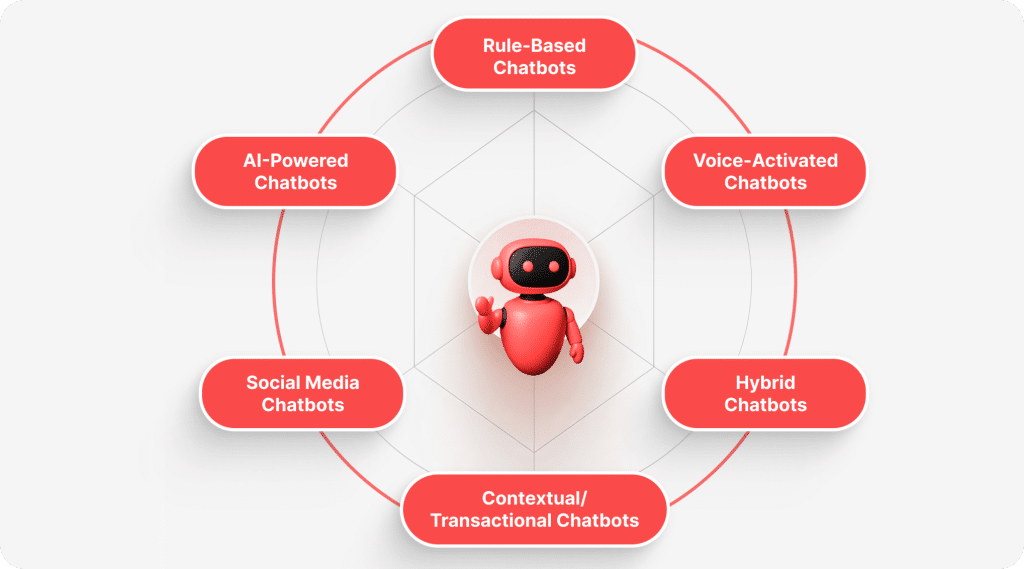
Various chatbot types are designed to meet different business objectives and user expectations. From simple rule-based bots that follow predefined scripts to advanced AI-powered assistants capable of understanding natural language, the range of chatbot technologies offers unique features and capabilities suited for diverse applications.
For example, Triviat is designed to combine the strengths of multiple approaches – delivering natural, human-like conversations across voice and chat, while also being flexible enough to handle both predictable and complex interactions. As we review the main types of chatbots, you’ll see how Triviat builds on these foundations to provide an all-in-one solution for modern businesses.
1. Rule-Based Chatbots (Decision-Tree Bots)
Decision-tree bots are rule-based chatbots that operate on predefined rules and structured conversational flows. They guide users through a series of menu options or questions, leading to a specific answer or outcome. These bots are perfect for handling repetitive, predictable tasks such as answering FAQs, booking appointments, or routing inquiries to the right department.
- Pros: Quick to build, simple, efficient for limited use cases.
- Cons: Lack flexibility, no AI or NLP capabilities, poor at handling unexpected queries.
2. AI-Powered Chatbots (NLP-Based)
AI-powered chatbots use Natural Language Processing (NLP) to understand and respond to free-form user input in a more natural, conversational way. Unlike rule-based bots, they don’t rely on prewritten scripts. Instead, they analyze intent and provide context-sensitive replies. These bots are best suited for unpredictable conversations such as tech support, personalized recommendations, or general virtual assistant tasks.
- Pros: Human-like, adaptive, continuously learning.
- Cons: More complex to build and maintain, higher cost.
Triviat is built on advanced NLP, enabling conversations in 50+ languages with natural tone and empathy – something traditional AI chatbots often struggle to achieve.
3. Voice-Activated Chatbots
Voice chatbots use speech recognition and NLP to let people interact hands-free through smartphones, smart speakers, or voice-enabled apps. Well-known examples include Siri or Alexa. They’re invaluable when typing isn’t convenient – such as while driving, cooking, or multitasking.
- Pros: Fast, hands-free, increasingly accurate.
- Cons: Limited by context understanding, often reliant on specific ecosystems.
4. Hybrid Chatbots (AI+Rule-Based)
Hybrid chatbots blend rule-based scripts with AI-powered flexibility. They handle routine tasks via structured menus but switch to AI when users go off-script. This makes them both reliable and adaptable – ideal for businesses that want structure without sacrificing natural conversations.
5. Social Media Chatbots
These bots live inside platforms like Facebook Messenger, Instagram, WhatsApp, or X (Twitter). They let brands interact with customers where they already spend time, offering quick answers, product suggestions, or 24/7 support without forcing users to leave the app.
6. Contextual/Transactional Chatbots
These chatbots go beyond simple Q&A – they remember the user’s conversation history, preferences, and past interactions. They’re perfect for tasks like booking flights, processing payments, or handling customer service issues where context and continuity matter.
With Triviat, contextual intelligence is baked in: it remembers conversations, adapts to the user, and ensures seamless continuity between voice, chat, and live agents.
How to Choose the Right Chatbot
With so many chatbot types available, the first step isn’t to pick the technology – it’s to get clear on your business objectives and your customers’ needs. Do you want to reduce support costs, improve response times, boost sales, or simply make your service available around the clock? Or maybe all of the above? The complexity of these goals will determine whether you need a simple rule-based bot or a more advanced AI-driven assistant.
Here are a few key factors to guide your decision:
- Business goals: What problems are you solving – FAQs, sales conversions, or complex customer support?
- User experience: Do your customers expect quick, scripted answers or natural, human-like conversations?
- Budget & resources: Consider both upfront investment and ongoing maintenance.
- Scalability: Will your solution grow with you – across new markets, languages, and channels?
The right chatbot is the one that aligns with your strategy while making life easier for your customers. For many companies, this means starting simple and evolving over time. Platforms like Triviat help bridge this gap by offering AI-powered conversations where customers expect more.
Triviat’s Take: Which Chatbot Works Best?
There’s no single “best” chatbot for every company – it always comes down to your goals and your customers. That’s why Triviat.AI is built to cover the full spectrum. Triviat brings it all together in one platform.
Here’s how it works in practice:
- Omnichannel by design: Voice, WhatsApp, live chat, SMS, email, and custom integrations – Triviat connects with customers wherever they are.
- Tailored to your brand: Your AI agent is trained on your data, set up with your workflows, and fine-tuned to match your tone of voice.
- Connected to your tools: With over 5,000 integrations (CRMs, calendars, eCommerce systems, and more), your AI agent plugs directly into your business ecosystem.
- Truly global: Conversations flow naturally in 50+ languages, 24/7.
- Powered by leaders: Triviat combines top technology from partners like AWS, ChatGPT, and Claude, ensuring speed, reliability, and natural dialogue.
The result? An AI agent that doesn’t just answer questions – it books appointments, follows up with prospects, sends notifications, and supports your team around the clock.
Ready to Get Started?
Chatbots come in many forms – from simple decision trees to advanced conversational AI – and each has its place. The key is choosing a solution that grows with your business and creates experiences your customers actually enjoy.
That’s where Triviat.AI makes the difference. By combining the strengths of all chatbot types into one platform, it helps businesses deliver fast, natural, and scalable conversations – across any channel, in any language, 24/7.
Ready to see it in action? Book a demo with Triviat today and discover how AI that sounds human can help your business grow.