Published March 5, 2026
Practical AI Implementation in Customer Service: Top 5 Success Cases

Customer service has always been the frontline of businesses. But for most companies, it’s also been the hardest operation to scale without sacrificing quality. AI is changing that, and 2025 is the year real-world results are starting to prove it.
The question is no longer “should we implement AI in customer service?” – that debate is settled. The question is how to make it work at scale, reliably, in a way that moves the needle on real business outcomes. This shift marks a new phase of enterprise AI implementation, where AI in customer support becomes core infrastructure rather than an experimental add-on.
AI customer service implementation challenges companies face today are worth naming upfront. Data silos leave AI working blind. Compliance requirements in banking and aviation are non-negotiable. Hallucinations damage reputation. ROI is hard to isolate. And change management quietly kills more projects than bad technology does. Every generative AI customer service case study shows that without governance and human oversight, automation at scale quickly becomes a reputational liability.
Five companies across different industries navigated all of this. Here’s what they built – and what actually happened.
Case 1 – MacPaw: Scaling 24/7 Customer Care with Human-in-the-Loop AI
The Challenge
MacPaw, the company behind Setapp, ClearVPN, and CleanMyMac, serves customers across dozens of countries and time zones. When your product portfolio spans multiple tools with very different user bases – from power users managing subscriptions to first-time VPN customers – a single generic support approach breaks down fast. The real challenge wasn’t just coverage. It was delivering fast, genuinely helpful responses 24/7, in the customer’s own language, without headcount growing faster than revenue.
The Implementation
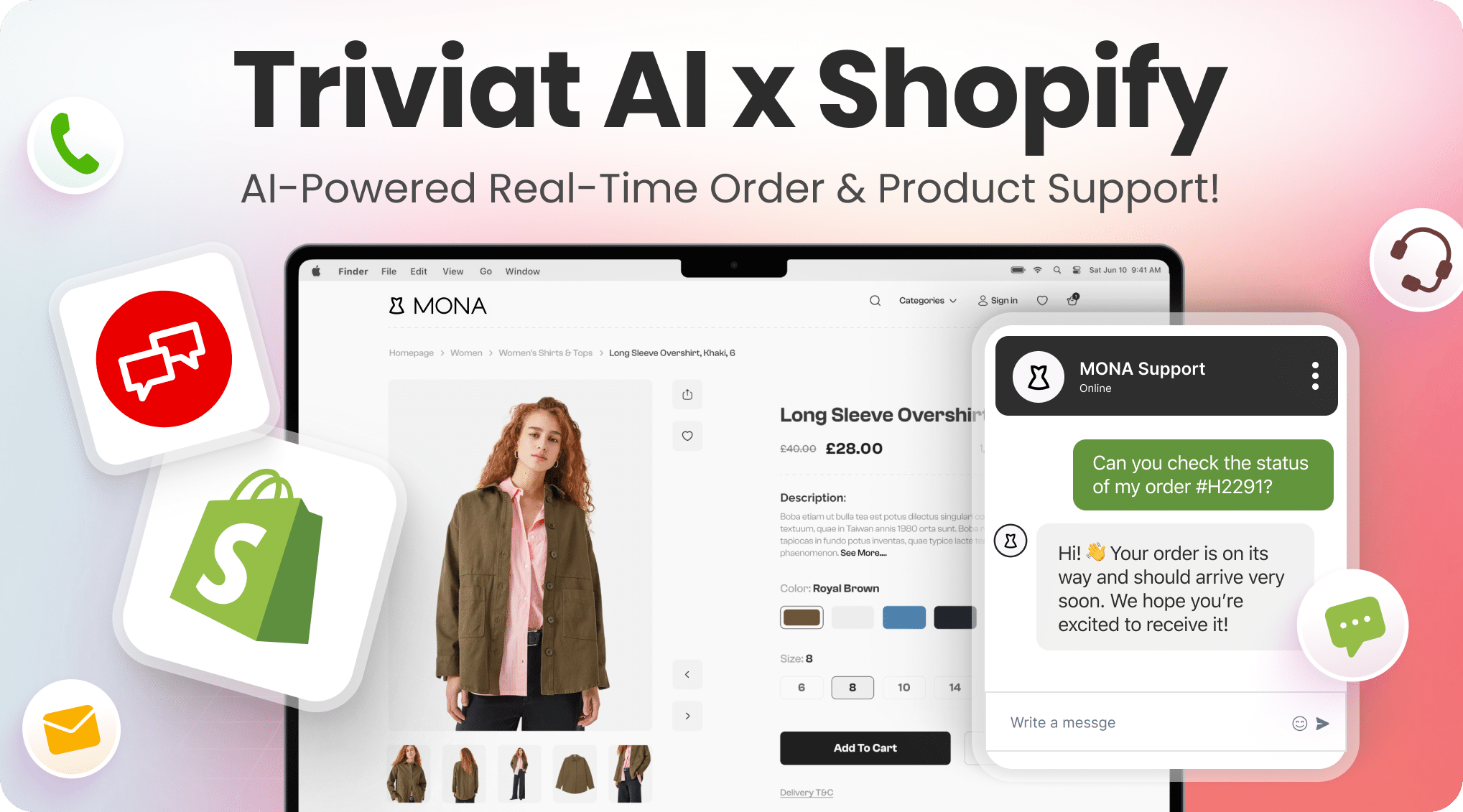
MacPaw chose Triviat as the intelligence layer for a reason that matters in production: it sounds like a human. Not a scripted responder cycling through canned answers, but a conversational AI that interprets intent, handles topic switches mid-conversation, and escalates gracefully when a human is the right call. It integrated natively with Zendesk, Intercom, and Freshcaller – so MacPaw could deploy across all three channels without rebuilding their support stack from scratch.
For email support, Triviat detected the language of each incoming message, translated it to English so agents could work in a single language, then localized the agent’s reply before it went out. For ClearVPN’s chat support on Intercom, Triviat handled roughly 90% of typical requests using a knowledge base, responding up to three or four times before handing off seamlessly to a human agent – flipping the chat status from “in progress” to “open” so the next available agent knew exactly where to step in. And for Setаpp’s U.S. toll-free hotline, Triviat’s voice AI served as the first point of contact, resolving what it could and transferring instantly when a customer asked for a human agent.
Business Impact
Triviat handled 90% of ClearVPN support requests automatically, delivering 24/7 multilingual coverage across multiple products – without proportional headcount growth. This is a practical conversational AI customer service case study that proves a simple point: AI in customer support works best when layered with human-in-the-loop design. AI handles volume and speed; humans handle nuance and relationship. That division isn’t a compromise – it’s what makes both sides work better.
Case 2 – BBVA: AI-Native Banking at Scale
The Challenge
For a bank operating in 25+ countries, AI implementation is a compliance and trust decision as much as a technology one. BBVA needed to modernize customer interactions without compromising data security, regulatory requirements, or accuracy standards that banking demands.
The Implementation
Built on an AWS-based AI platform called ADA, BBVA gave internal staff access to ChatGPT Enterprise and Google Gemini, and developed “The Eight” – a multi-agent framework where specialized AI agents collaborate on complex tasks.
The customer-facing centerpiece is Blue, BBVA’s virtual assistant rebuilt on generative AI. It handles up to 150 query types and responds to more than 3,000 variations of customer questions – while staying exclusively focused on banking topics for accuracy and compliance. Personal and transactional data never leaves the bank’s systems.
Business Impact
An internal AI tool gives branch employees real-time access to more than 30,000 product and service references, dramatically reducing search time during customer interactions. BBVA currently holds the top position in Spain and fourth in Europe on the Evident AI Index for AI integration in banking.
Case 3 – Air France-KLM: Building a Generative AI Factory

The Challenge
Running two major airlines across 300+ destinations means legacy systems that don’t connect, multilingual support that must be instant and accurate, and query volumes that spike unpredictably. The deeper problem: every AI deployment had to solve the same foundational issues from scratch.
The Implementation
Together with Accenture and Google Cloud, Air France-KLM launched a dedicated Generative AI Factory – a cloud-based framework for identifying high-value use cases, testing them, and moving them into production using shared tools and methodologies. The impact was immediate: development cycles from experiment to enterprise-ready deployment improved by over 35%.
What makes this case interesting is how the factory approach translated into practical tools across the organization. Airport agents now use Pamelia directly on their iPads – when a passenger asks about baggage rules, live animal transport, or travel formalities, Pamelia searches Air France’s reference manuals and generates a ready-to-share response, translatable into 85 languages on the spot. Meanwhile, internally, staff across the company use Talia – Air France’s private AI assistant – for everyday tasks like drafting emails and searching documents, in a fully closed environment where no data leaves the company. And to close the feedback loop, FOX processes customer reviews at scale using generative AI, capturing sentiment across thousands of responses including ones that use irony or humor, the kind of nuance that simpler tools consistently miss.
Business Impact
Over 80 active AI projects across Air France. In 2025, the group retired 200+ legacy applications. Ancillary revenue grew 23% year-on-year. The factory model turns individual experiments into a repeatable system.
Case 4 – Sephora: Hyper-Personalization in Beauty Retail

The Challenge
Sephora’s problem wasn’t a lack of products – it was too many. Thousands of shades and formulas left customers overwhelmed. The wrong shade meant a return. No personalized guidance meant a lost sale. Moving this experience online required a fundamentally different approach.
The Implementation
Virtual Artist, developed with ModiFace, lets customers virtually try on thousands of makeup products in real time via phone camera, in-app, or in-store kiosks. The AI maps facial geometry, adjusts for skin tone and lighting, and sharpens recommendations over time.
Color IQ scans a customer’s face to identify their exact skin tone and match them to the right foundation across thousands of SKUs – removing the guesswork entirely. The Reservation Assistant on Facebook Messenger drove an 11% increase in booking rates within two years of launch.
Business Impact
Customers using Virtual Artist were 3x more likely to complete a purchase. Returns dropped 30%. Online sales grew from $580M in 2016 to over $3B by 2022. Average app session time went from 3 minutes to 12.
Case 5 – Verizon: AI as a Real-Time Sales and Support Engine
The Challenge
Getting 28,000 customer service representatives to actually trust and use an AI tool is a change management challenge as much as a technical one. Verizon also needed verifiable accuracy and measurable ROI – not theoretical efficiency gains.
The Implementation
With Google Cloud, Verizon built the Personal Research Assistant – a conversational AI trained on ~15,000 internal documents using Vertex AI and Gemini. It works proactively: suggesting relevant questions and surfacing answers in real time as agents type, with automated conversation summaries and follow-up reminders built in. This is a clear example of how AI and automation in call centers can evolve beyond scripted responses into real-time cognitive assistants supporting live conversations.
A separate Problem Solver agent handles advanced troubleshooting for both new and experienced agents. Piloted in July 2024 and fully live by January 2025, deployed across all 28,000 reps and retail staff.
Business Impact
95% accuracy in answering customer inquiries. ~40% sales increase following full deployment. Instead of reducing headcount, Verizon reskilled its workforce – transforming support agents into sales-capable employees.
What These 5 Companies Did Differently
The patterns across these cases are hard to miss.
AI that sounds human outperforms AI that sounds like software. The MacPaw + Triviat case makes this concrete. When customers interact with a natural, conversational AI assistant, they stay in the flow. When it feels mechanical, they escalate immediately. That distinction affects resolution rates, satisfaction, and how much load ever reaches a human agent.
Enterprise AI means ecosystem thinking. None of these implementations exist in isolation. They connect to CRMs, knowledge bases, and internal systems. The AI layer is only as good as the data infrastructure beneath it.
The hardest part isn’t the model – it’s the integration. Air France-KLM built a factory precisely because going from pilot to production requires a repeatable system, not just a good proof of concept.
Human-in-the-loop isn’t a compromise – it’s the design. MacPaw, Verizon, and BBVA all kept humans meaningfully in the loop. Triviat’s seamless handoff logic is a direct example: the AI handles what it can, and the transition to a human is instant and invisible to the customer.
Summary comparison:
| Company | Industry | AI Tool | Key Result | Core Challenge Solved |
| MacPaw + Triviat | Software/SaaS | Triviat chat + email + voice | 90% of ClearVPN requests handled automatically | 24/7 multilingual support at scale |
| BBVA | Banking | Blue GenAI assistant | 150 query types, 30,000+ internal refs | Compliance + agent cognitive load |
| Air France-KLM | Aviation | Pamelia, Talia, FOX + Gen AI Factory | 35% faster dev cycles, 80+ AI projects | Legacy systems + multilingual ops |
| Sephora | Beauty Retail | Virtual Artist + Color IQ | 3x purchase likelihood, 30% fewer returns | Shade uncertainty + personalization |
| Verizon | Telecom | Personal Research Assistant (Gemini) | 95% inquiry accuracy, ~40% sales increase | 28,000 agents + ROI at scale |
AI Implementation in Customer Service: The Real Challenges
These are success stories – precisely because these companies were honest about the obstacles. Here’s what actually makes enterprise AI in customer service difficult.
Legacy systems. Integrating modern AI with decade-old CRMs and ticketing systems is typically the longest part of any implementation. Air France-KLM’s answer: cloud migration first, then AI.
Compliance differences by industry. Banking AI has different constraints than aviation AI or retail AI. BBVA’s Blue works exclusively on banking topics and keeps all data inside the bank’s systems. Generic solutions rarely survive contact with regulated environments.
Data fragmentation. AI without context is AI working blind. Customer data split across sales, support, billing, and product systems that don’t communicate is the norm – not the exception. MacPaw’s next phase of integrating Triviat with live account data is exactly the right move.
Human adoption. Verizon deploying to 28,000 reps is a change management program. Tools agents don’t trust don’t get used. The Personal Research Assistant was designed to assist, not replace – a distinction that drives adoption more than any training program.
Measuring real ROI. Verizon’s ~40% sales increase is unusually concrete. Most companies struggle to isolate AI’s contribution. Setting baseline metrics before deployment makes a significant difference.
Moving from pilot to scale. A proof of concept is not a production system. Air France-KLM’s gen AI factory exists specifically to bridge that gap – standardizing what it takes to go from experiment to enterprise deployment.
What Comes Next: 2026 and the Agentic AI Era

The companies in this article didn’t just implement AI – they built the infrastructure to keep improving it. That’s the shift that defines where customer service is heading.
2026 is shaping up to be the year of agentic AI in customer service: systems that don’t just answer questions but take actions, coordinate across tools, and operate with greater autonomy. Agentic AI in customer service represents the next stage of enterprise AI implementation – moving from assistive tools to coordinated AI agents that manage entire workflows. BBVA’s ‘Eight’ framework is an early version. Air France-KLM’s factory is designed to deploy it at speed.
What the MacPaw case shows – and what Triviat is built around – is that the human-like quality of the AI isn’t a nice-to-have. It’s the foundation. An AI that sounds natural, escalates gracefully, and works seamlessly across voice, chat, and email doesn’t just reduce support costs. It serves customers better. And that’s the version of AI customer service that actually builds loyalty.
Customer service isn’t being replaced by AI. It’s being reinvented by it. The question is whether your organization is building for the next demo, or the next five years.
Ready to see Triviat in action? Book your free demo today.